Direct answer: map linen from receipt to collection
A useful salon linen-flow brief should define what linen is used for each service, how clean stock arrives, where it is checked and stored, how it reaches treatment stations, where used items are contained, how long they wait, and how they leave without crossing customer experience or clean preparation unnecessarily. It should record peak demand, laundry turnaround, container dimensions, staff ownership, cleaning interfaces and collection access. Dubai Municipality publishes salon and laundry-related health and safety guidance, but the applicable requirements must be confirmed for the specific activity and licence. A pair of cupboards labelled clean and used is not a complete operational plan.
Quantify demand from the service menu
List each service that uses towels, capes, sheets, robes or reusable cloths. Estimate items per service, concurrent stations, peak appointments, changeover time and reserve stock. Then test a normal day, a peak day and a delayed collection. The operator should own these assumptions because equipment and layout cannot compensate for an unrealistic laundry cycle. Separate reusable client linen from staff cloths or specialist items where the approved operation requires it. Keep counts as planning inputs rather than public claims. Update the model if the service menu, opening hours or station count changes.
Protect clean stock from handling and moisture
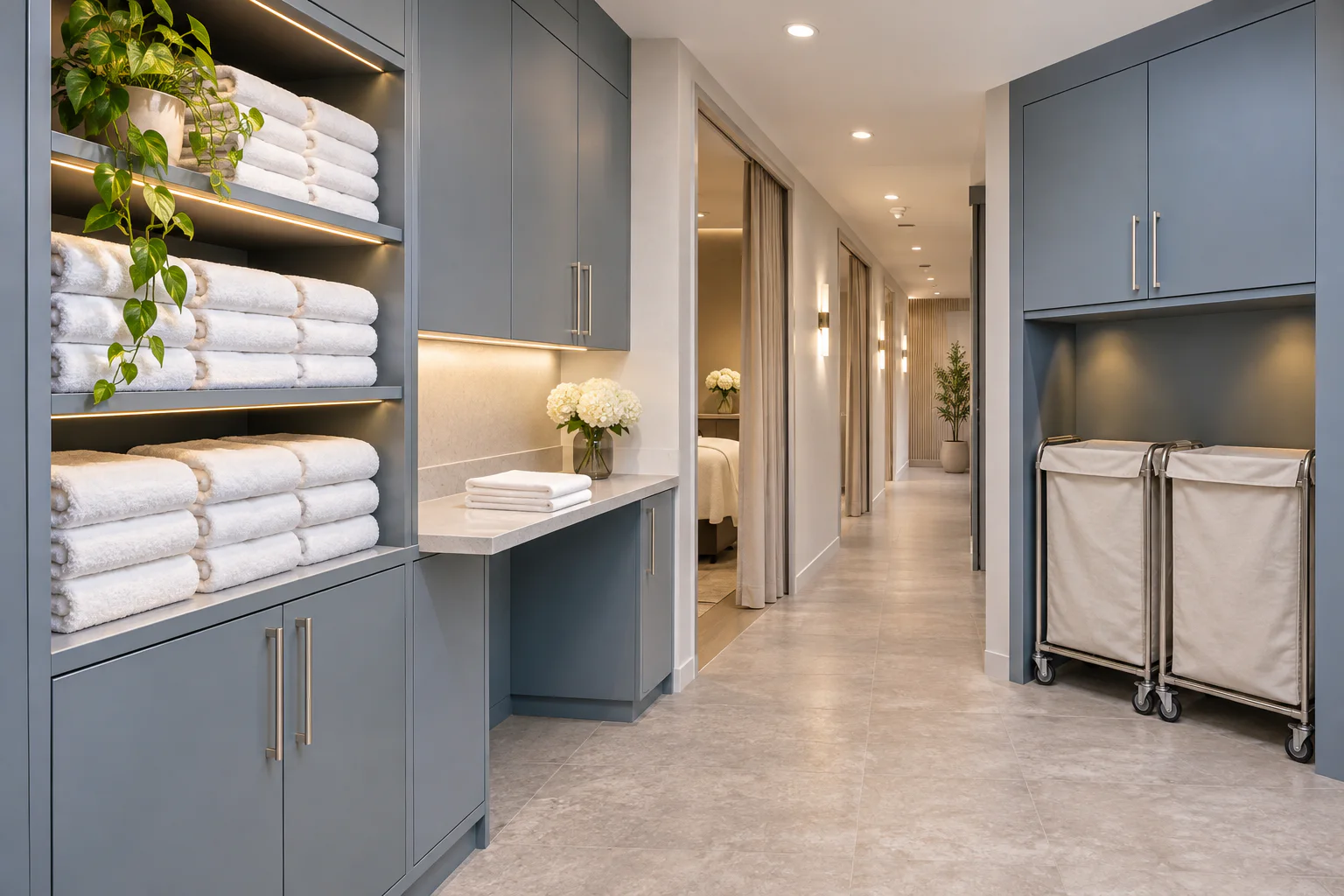
Define how clean linen is delivered, unpacked, checked and transferred into enclosed or otherwise suitable storage. Locate daily stock close enough to stations for efficient replenishment without placing it in splash, chemical preparation or used-item zones. Record shelf depth, stack height, door clearance and the ability to clean the surrounding surfaces. Dubai Municipality’s Ideal Salon Technical Guidelines emphasise covered tool storage, specialised work areas, cleanliness and appropriate ventilation. The appointed health and operational advisers should interpret current requirements for the specific salon and services rather than relying on a generic cabinet detail.
Size and locate used-linen holding
Select proposed bags, hampers or closed carts early and obtain their real dimensions, lid operation, manoeuvring space and collection method. Position holding so staff can deposit used items without carrying them through clean storage or customer waiting areas where avoidable. Check that containers do not block sinks, doors, fire equipment, accessible routes or cleaning access. The brief should state who closes, moves and exchanges containers, but detailed hygiene procedures belong to the operator’s approved policies and current authority guidance. Ventilation, drainage and fire implications require the relevant consultants where applicable.
Planning example
Planning example: a salon has eight styling stations, two treatment rooms and an outsourced daily laundry collection. The first layout provides one towel cupboard near reception and leaves used hampers in a rear corridor. The operational review shows that peak use exceeds the cupboard capacity and the hampers narrow the staff route. The revised brief adds distributed daily clean stock, a larger enclosed reserve store and a recessed used-linen bay sized to the selected wheeled containers. Collection is routed through the service entrance. This fictional scenario demonstrates coordination only; it is not an approved compliance solution.
Coordinate the staff route and collection interface
Trace replenishment from reserve store to each service area and used-linen return to the holding point. Add the external collection route through loading, lifts, doors and landlord-controlled areas. Confirm booking, access and protection requirements with building management. Avoid routes that rely on leaving containers temporarily in corridors. Test the route during a peak appointment changeover, not only when the salon is empty. Check door swings, trolley turning, threshold changes and where staff can pause without obstructing customers, accessible circulation or emergency equipment. If clean delivery and used collection share an access point, the operator and health adviser should define timing and containment controls. Include space for counting, folding or decanting only if those tasks actually occur on site and are permitted within the approved operation. Record how a delayed collection changes holding capacity and who escalates it.
Checklist before layout freeze
Review the plan with the operator, designer, health adviser, laundry provider and building representative where relevant. Use the actual container and shelf dimensions and mark every assumption that remains subject to approval.
- List linen types and use per salon service
- Model normal, peak and delayed-collection demand
- Confirm clean delivery, reserve and daily-stock locations
- Measure shelves, bags, hampers and wheeled containers
- Separate clean handling from used-item holding
- Trace replenishment and collection routes
- Check doors, lifts, circulation and cleaning access
- Assign operational ownership and collection frequency
- Record current Dubai Municipality references and approvals
Limitations and authority context
This article does not provide infection-control, laundry-processing, occupational-health, fire-safety or licensing instructions. The operator, appointed health and safety professionals, consultants, laundry provider, landlord and relevant authorities must confirm the applicable requirements. Dubai Municipality maintains a current technical-guidelines list that includes salon and laundry activities; documents and interpretations can change. Product registration and professional-use requirements may also apply to consumer products used in the salon. Do not infer compliance from the appearance of a design concept. Any late change in service menu or container system should reopen the capacity and route review.
Next step: run one peak-day linen trace
Put the service schedule, linen counts, container data and latest plan into one workshop. Trace a clean delivery, station replenishment, used-item deposit, peak holding period and collection. Record who performs each step, what they carry, where it waits and which doors or lifts they use. Test a delayed collection and the busiest planned changeover so the review exposes reserve-capacity and obstruction risks rather than only the normal sequence. Convert unresolved questions into assigned actions and update the room data, equipment list and joinery schedule. Freeze the layout only after the operator accepts the capacity and the responsible advisers confirm that the proposed separation, access and operational interfaces are suitable for the approved salon activity.
Sources & further reading
Make this useful for your project.
A review of your property and priorities can turn general guidance into a defined brief.
Explore Salon fit outDiscuss your project